projects


Kyoto Sangyo Univ.
Kimura Lab
Plant can alter their development, physiology and life history depending on environmental conditions. This fundamental property is called phenotypic plasticity.
The North American lake cress, Rorippa aquatica is an herbaceous perennial aquatic mustard. Typical habitat of lake cress is at shores of ponds, slow-moving streams and other quiet waters in North America. The lake cress shows heterophylly, phenotypic plasticity on leaf shape. In nature, the leaf shape of this plant depends on whether the plant is submerged in or emergent from water (Fig. 1). Submerged leaves are usually deeply dissected and has needle-like blade, whereas emergent leaves are generally entire with serrated or smooth margins. This phenotypic plasticity on leaf shape is thought to be adaptive response to submergence and increase the fitness in water's edge environment where most of lake cress populations are found. Interestingly, the leaf shape changes in response to varying temperature and light intensity, as well as to underwater submergence (Fig. 2)
Despite the significance of this plant to study fundamental mechanisms of phenotypic plasticity and environmental responses in plants, the underlying mechanism hasn't been investigated. We investigate the mechanism of the heterophylly of Rorippa aquatica.
(1) Analysis of Phenotypic Plasticity of Leaf shape of Lake cress
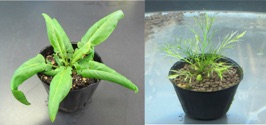
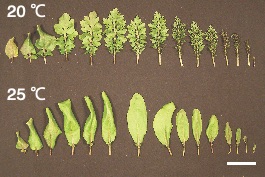
Figure 1. Heterophylly of of Lake cress
(Left) Aerial leaves
(RIght) Submerged leaves
Figure 2. Effect of temperature on leaf shape of Lake cress
(2) Evo/Dev study on leaf shape
(3) Analysis of genome maintenance mechanisms of plants
DNA is constantly suffers many kinds of damage caused by the action of exogenous agents such as ionizing radiation, ultraviolet light and chemical mutagens. DNA damage response system, which stimulate DNA repair, cell cycle checkpoint and eventually programed cell death, is crucial to maintain genome stability.

Arabidopsis SOG1 is a plant specific transcription factor which governs the transcriptional regulation of more than 100 genes, cell cycle arrest and programed cell death in response to DNA damage. We demonstrated that SOG1 is phosphorylated by ATM and this phosphorylation is essential for cell cycle arrest, transcriptional regulation and induction of programmed cell death. Although the amino acid sequence of SOG1 is completely different from that of the mammalian tumor suppressor p53, their function and roles in DNA damage response are quite similar. Our current study illuminates new aspects of regulatory mechanism of SOG1 functions and DNA damage response in plants.
This project is directed by Kaoru Yoshiyama, PhD.
Figure 4.DNA damage response of mammals and plants.
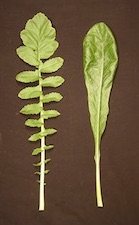
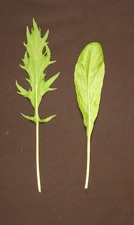
Figure 3.
(Left) Mizuna
(Right) Mibuna
Figure 4.
Compound (left) and simple (right) leaf type of Japanese Daikon radish.
Variation of leaf shape is one of the most striking example of the diversity of plants. We are investigating the genetic and developmental basis of the variation by analyzing natural variation of leaf shape.
Kyoto, where our university is located, is famous for breeding vegetables and some of the Kyo-Yasai (Traditional vegetables in Kyoto) have weird shape. For example, Mizuna (Brassica rapa var. nipponsinica) is one of the typical Kyo-Yasai, and has deeply lobed leaves, while Mibuna (B. rapa var. laciniifolia), which is developed from Mizuna by breeding in 19 th century, has entire leaves with smooth margin (Fig. 3) . We are interested in genetic basis of leaf shape variation between Mizuna and Mibuna. We are also interested in leaf shape variation which is seen between varieties of Japanese Daikon Radish (Fig. 4).