Generation of neural primordia in vertebrate embryos by mechanisms that challenge the classical models
Hisato Kondoh
Graduate School of Frontier Biosciences, Osaka University
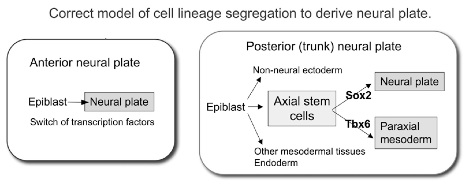
The textbook view holds that segregation of the three germ layers (ectoderm, mesoderm, endoderm) is the process specifying cell lineages in early embryos. Our study challenges this, by showing that paraxial mesoderm (which gives muscle and bone) and posterior neural plate (spinal cord precursor) are in fact derived from common bi-potential precursors “axial stem cells” in the caudal lateral epiblast. This requires Tbx6 (a mesoderm-dedicated regulator) to turn off Sox2 (a neural regulator). Because of this, Tbx6-null mouse embryos develop ectopic neural tubes at the expense of paraxial mesoderm. Cell type specification is therefore separate from germ layer formation. Our study further shows that anterior neural plate (brain precursor) is derived directly from the epiblast (embryonic blastoderm). The mechanisms to derive neural plate differ depending on the embryonic axial levels. These findings will impact on contemporary stem cell research, where the regulation of cell lineage specification is the major issue.